Marina Abramovic - Balkan Baroque (1997)
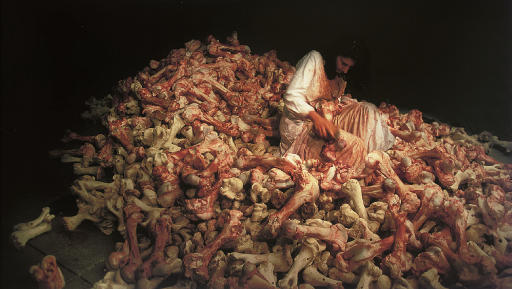
Marina Abramovic's Balkan Baroque (1997) was an performative installation shown at the Venice Biennale (the artist called it a "play", perhaps hinting at the piece's theatricality). It incorporated several channels of video, but the central image was that of the artist washing more than one thousand ox bones, an act that took four days and six hours. During the duration of the performance, she sang Balkan folk songs to herself from memory. The ritualistic and obsessive cleaning coupled with the melodies of her childhood seem to outline the reinforcement and repetition of subjective shame through a remembered past. In an interview, she said of the piece: "I'm trying to deal with my own emotions, for example with this tremendous feeling of shame which I have about [The Yugoslav Wars]. As an artist, you can only deal with what there is inside you. I'm making this play because it is the only way to react emotionally to the war." This particular statement is interesting in what is left out: what is the shame she experiences as a former citizen of this country? We are not made privy to her memories beyond a fractured narrative of song, but presumably a guilt lingers from her past as a Serbian resident of the Balkans; perhaps a collective apology springs silently from her lips between notes.
Sophie Calle - Les Dormeurs [The Sleepers] (1980)


One of Sophie Calle's first works involved photographing multiple people sleeping in her bed. The images' rigid and gridded display seems to imply a scientific survey, a desire to accurately capture the vulnerability of sleep. In Aperture magazine, Giuseppe Merlino says of her practice: "The intimacies she recounts, with texts and images, are not the results of encounters, attractions, or affinities, but of an accumulation of observed details, from the programmed obsessiveness of a collector-voyeur." There is a uneasy tension between what is usually thought of as an intimate and personal performance of bed-sharing and its rigorous exhibition for an indifferent public. Calle's work could, perhaps, be considered the first step towards reality television, a medium that is neither strictly documentary nor strictly fictional, but instead a blend of the two that blooms from a desire to mediate common experiences made strange through the very act of their documentation; it's a bizarre feedback loop.
Michael Fernandes - Room of Fears (2006)

Michael Fernandes' Room of Fears was created from one-sentence statements of fear submitted by the public through various means (email, comment boxes, & physical ballot boxes placed around the city of Halifax). The resulting fears, collected over the period of one month, were then transcribed onto the gallery walls, in a configuration that, for me, called back memories of the practice of making problem students repetitiously write a self-disciplinary adage on the blackboard. The performance action of reading and rewriting these fears was probably transformative for the artist and his assistants; I'm sure there were fears that were both eerily similar and vastly different from their own. The repetition of the phrase, "I'm afraid of..." reinforces the importance of fear in human lives; it is an emotion that everyone experiences, and plays an important role in the way we conduct ourselves in a social sphere. The work is made all the more powerful by the anonymity of its multitude of participants, and acts as a mechanism to universalize the concept.
Rich and Fabulous (Deej Fabyc & Elvis Richardson) - Eye Witness Frenzy(2002)

A collaborative installation of several works between two artists highlights traces of the performances of other people. Elvis Richardson's Slide Show Land is a collection of 30,000 family vacation slides purchased from all over the world. It speaks directly to construction of memory through a tourist-y photographic vernacular, as is mentioned in the exhibition catalogue: "So generic they are familiar, through this work we enter unfamiliar lives even if they do not seem to be so different from ours." Deej Fabyc's works, KJ's Story and I Am Me You Are You, provide a much more personal note to the installation; KJ's Story is a video work consisting of a collection of family photographs from a woman known only as KJ, who sings REM over the slideshow. I Am Me You Are You is a sculptural collaboration between Fabyc and her daughter, consisting of a collection of dolls in a cardboard box, each individually lit by their own night-light. It is accompanied by a video of Fabyc's daughter reciting "I Am Me, You Are You" repetitiously. The installation simultaneously universalizes and personalizes subjective & memory construction through image, and points to a societal obsession with life-documentation that has only become worse with the advent of digital technologies.
John Bock - Klutterkammer (2004)

John Bock's Klutterkammer was as messy as the majority of Bock's work seems to be. The title seems to reference the Wunderkammer, or Cabinet of Curiosities, a popular method of displaying one's important or strange objects during the European renaissance. It consists of a collection of his film works, as well as a fractured display of inspirations that range from Theatre of Blood to Paul McCarthy. The inspirations are housed in makeshift dens made from materials like hay or tinfoil, providing the installation-based element of the show. An exhibition review recounts the performance that kicked off the show: "Bock diagrammatically explained a theory of art-economy with the aid of some black gaffer tape, a punctured sausage and a portrait of John Maynard Keynes" (Sarah James, Art Monthly, 11/04). With his bizarre symbology and installation-based performance, an obvious comparison can be drawn to Joseph Beuys, whom the artist included within his inspirations. Klutterkammer reads as an elaborately mythologized self-portrait, a heavily constructed display of his own subjectivity, which can garner apt criticism: "There is a danger that his meaninglessness undermines the work's productivity, or that his supposedly liberating game of referencing is only so to those who can follow it. If this is the case, it becomes closer to a self-satisfying circular art world discourse..." (James).

No comments:
Post a Comment