Tuesday, April 14, 2009

grit & grain : dislocation, displacement, diaspora & the new village project


"Grit & Grain" - video installation

The video piece "Grit & Grain" is documentation of the building of sand-piles composited with city scenes and text. The ritualistic nature of the sand-piling and its symbolic separation and amalgamation provides a foil to colonialism and globalization, two of the chief factors in dislocation & diaspora. Colonialism involves the dividing of countries along unrealistic territorial lines that benefit political conquerors, and globalization involves the consolidation of assets to uphold the new conquerors of commercialism. Same sand, different pile.

Budget & Technical Requirements
(rentals from VIVO @ artist's rate)

video projector : $75
DVD player : $4

Venue

The ideal venue for a piece such as this is an urban space where it will be stumbled across unexpectedly, such as in an alley. If it were presented in the context of a festival, any obscured & darkened corner of the space outside the gallery could be used.

Resume


performance festival : dislocation, displacement, diaspora, & creation of the new village

Jennifer Somerstein's work was a humourous narrative video that depicted a situation in which two people had switched voices. Outside help was sought, and through simple household magic voices were re-jumbled, with one character receiving her proper voice back and leaving the other two to sort through the issue alone when the scene closes. Somerstein's piece depicts the jarring nature of displaced voices, and their importance to issues of identity.

--

Yota Konishi's work was a class-long durational performance wherein he used a computer to do repetitive strength training. He lifted the tower with squats, did crunches with the keyboard, and hefted the monitor. The piece was inevitably both comic and poignant, reflecting a tension in the displacement of the physical body in relation to new cyberworlds.

--

Patrick Cruz entered the space wearing a tall mask of an old, bearded white man. He wore a white hoodie and white spandex pants stuffed with styrofoam balls. Once he had entered the space and sat down, he removed the mask and the styrofoam balls from his pants and read to the audience in Spanish from papers... or maybe he just spoke and used the papers as a prop? The style of his oration was casual and stumbling, and he picked his nose while talking. After the performance, he stated that he had been narrating what he was doing. This piece toyed with notions of dislocation of traditional authority (white mask, big balls) and the banality of performance art.

--

Martina Comstock performed a stream-of-consciousness writing exercise that was projected onto her face wrapped in white cloth. It seems as if she is working within modes of constructed identity and the dislocation of self into new, cybernetic forms that have very little to do with the physical subject's presence in space.

--

Genevieve Cloutier, Grant Hash and Anna White presented video documentation of a collaborative piece that involved the construction and dismantlement of a temporary house structure in the urban environment. Literally engaged in the construction of a new village through a collaborative blog (www.showandtellvancouver.blogspot.com), the artists' gesture seems to be a call to the formation of community-based art practice and a coinciding self-sufficiency praxis within a city space.

--

Andy Lee's video "Drop" is a colorful blend of hip-hop and Asian culture, featuring Andy rapping and an Asian friend performing tricks with a basketball. It references recent popular culture trends in remixing and cultural appropriation. It seems to confront issues of globalization and its consequences in cultural osmosis.

--

Derya Akay's video chat projection involved the screening of a Satanism documentary with a composite image of him and a "googled" image of Satanism in the lower left hand corner. According to Derya, his video chat pointedly failed, though I was unclear as to the conceptual reasons for that. It was an interesting comment on myth; the Satanism documentary was obviously made by an antagonistic party but the imagery presented in the piece's accompanying pamphlet-zine was a wide range of different, "evil" imagery that seemed to be compiled from a myriad of different ideologies.

--

Ruben Castelblanceo's video projection was a short loop of powerful audio and fractured imagery that featured a long-haired protagonist in various states of tension and relaxation. It was visually impactful and operated very well as an immersive installation with its intensity of sound.

Monday, March 30, 2009

obsession with/collection of memory : archival performance installation/traces

Memory is a ghostly presence in human lives, a haunting environment of inner thought that heavily informs interactions with an outer world. It is a subjective account of the past that cannot be fully confirmed even by the most stringent documentation and it is taken for granted that people remember things vastly differently. A memory, like any other sort of knowledge, is constructed and augmented over time through reiteration, and its traces diffuse throughout behaviour, relationships, and actions of a subject. To some extent, we all collect and obsess over memories, eventually forming an interstice in which we etch out a notion of self. All of the artists that I have chosen work with repetition and physical, photographic or linguistic traces of performance actions, which are in and of themselves a metaphor for memory as they leave a trace that is both similar and different from the experience of the performance itself.

Marina Abramovic - Balkan Baroque (1997)
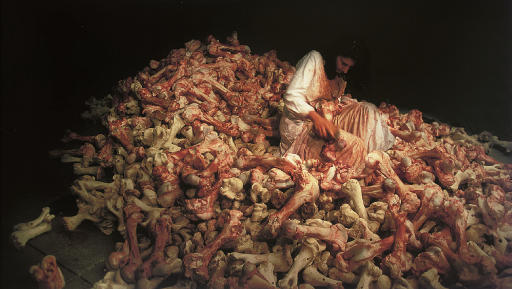


Marina Abramovic's Balkan Baroque (1997) was an performative installation shown at the Venice Biennale (the artist called it a "play", perhaps hinting at the piece's theatricality). It incorporated several channels of video, but the central image was that of the artist washing more than one thousand ox bones, an act that took four days and six hours. During the duration of the performance, she sang Balkan folk songs to herself from memory. The ritualistic and obsessive cleaning coupled with the melodies of her childhood seem to outline the reinforcement and repetition of subjective shame through a remembered past. In an interview, she said of the piece: "I'm trying to deal with my own emotions, for example with this tremendous feeling of shame which I have about [The Yugoslav Wars]. As an artist, you can only deal with what there is inside you. I'm making this play because it is the only way to react emotionally to the war." This particular statement is interesting in what is left out: what is the shame she experiences as a former citizen of this country? We are not made privy to her memories beyond a fractured narrative of song, but presumably a guilt lingers from her past as a Serbian resident of the Balkans; perhaps a collective apology springs silently from her lips between notes.

Sophie Calle - Les Dormeurs [The Sleepers] (1980)


One of Sophie Calle's first works involved photographing multiple people sleeping in her bed. The images' rigid and gridded display seems to imply a scientific survey, a desire to accurately capture the vulnerability of sleep. In Aperture magazine, Giuseppe Merlino says of her practice: "The intimacies she recounts, with texts and images, are not the results of encounters, attractions, or affinities, but of an accumulation of observed details, from the programmed obsessiveness of a collector-voyeur." There is a uneasy tension between what is usually thought of as an intimate and personal performance of bed-sharing and its rigorous exhibition for an indifferent public. Calle's work could, perhaps, be considered the first step towards reality television, a medium that is neither strictly documentary nor strictly fictional, but instead a blend of the two that blooms from a desire to mediate common experiences made strange through the very act of their documentation; it's a bizarre feedback loop.

Michael Fernandes - Room of Fears (2006)


Michael Fernandes' Room of Fears was created from one-sentence statements of fear submitted by the public through various means (email, comment boxes, & physical ballot boxes placed around the city of Halifax). The resulting fears, collected over the period of one month, were then transcribed onto the gallery walls, in a configuration that, for me, called back memories of the practice of making problem students repetitiously write a self-disciplinary adage on the blackboard. The performance action of reading and rewriting these fears was probably transformative for the artist and his assistants; I'm sure there were fears that were both eerily similar and vastly different from their own. The repetition of the phrase, "I'm afraid of..." reinforces the importance of fear in human lives; it is an emotion that everyone experiences, and plays an important role in the way we conduct ourselves in a social sphere. The work is made all the more powerful by the anonymity of its multitude of participants, and acts as a mechanism to universalize the concept.

Rich and Fabulous (Deej Fabyc & Elvis Richardson) - Eye Witness Frenzy(2002)


A collaborative installation of several works between two artists highlights traces of the performances of other people. Elvis Richardson's Slide Show Land is a collection of 30,000 family vacation slides purchased from all over the world. It speaks directly to construction of memory through a tourist-y photographic vernacular, as is mentioned in the exhibition catalogue: "So generic they are familiar, through this work we enter unfamiliar lives even if they do not seem to be so different from ours." Deej Fabyc's works, KJ's Story and I Am Me You Are You, provide a much more personal note to the installation; KJ's Story is a video work consisting of a collection of family photographs from a woman known only as KJ, who sings REM over the slideshow. I Am Me You Are You is a sculptural collaboration between Fabyc and her daughter, consisting of a collection of dolls in a cardboard box, each individually lit by their own night-light. It is accompanied by a video of Fabyc's daughter reciting "I Am Me, You Are You" repetitiously. The installation simultaneously universalizes and personalizes subjective & memory construction through image, and points to a societal obsession with life-documentation that has only become worse with the advent of digital technologies.

John Bock - Klutterkammer (2004)


John Bock's Klutterkammer was as messy as the majority of Bock's work seems to be. The title seems to reference the Wunderkammer, or Cabinet of Curiosities, a popular method of displaying one's important or strange objects during the European renaissance. It consists of a collection of his film works, as well as a fractured display of inspirations that range from Theatre of Blood to Paul McCarthy. The inspirations are housed in makeshift dens made from materials like hay or tinfoil, providing the installation-based element of the show. An exhibition review recounts the performance that kicked off the show: "Bock diagrammatically explained a theory of art-economy with the aid of some black gaffer tape, a punctured sausage and a portrait of John Maynard Keynes" (Sarah James, Art Monthly, 11/04). With his bizarre symbology and installation-based performance, an obvious comparison can be drawn to Joseph Beuys, whom the artist included within his inspirations. Klutterkammer reads as an elaborately mythologized self-portrait, a heavily constructed display of his own subjectivity, which can garner apt criticism: "There is a danger that his meaninglessness undermines the work's productivity, or that his supposedly liberating game of referencing is only so to those who can follow it. If this is the case, it becomes closer to a self-satisfying circular art world discourse..." (James).

Tuesday, February 24, 2009

Durational Work : Tehching "Sam" Hsieh - Time Piece (1980-1981)

For one year, Tehching Hsieh (going by Sam at the time) attempted to punch a time clock every hour on the hour. Every punch of the clock was documented: by 366 punch cards signed by witness David Milne, at the time Executive Director of the Foundation for the Community of Artists in New York, who produced a statement to confirm that he had signed them; and by a single frame of 16mm film, creating a stopframe animation of his year at the clock that passes in about six minutes. He shaved his head at the beginning of the performance to show the passage of time, and produced documentation of his failures to punch the clock (only 134 times out of a potential 8,760). A statement produced by Milne at the end of the piece confirms the authenticity of his signatures on the cards, and the fact that the 16mm film strip is unaltered.

At the time, Hsieh was living as an illegal alien in New York City, and had been since 1974. An illegal alien is deported if apprehended and is thus a "subject without rights but
nonetheless defined by the exercise of legal force" (Ward). A curious interstitial space to occupy as a performance artist. Hsieh's neurotically notarized documentation of his life at the clock seems to mimic the idea of employee surveillance, "hyperboliz[ing] the
subjection of the worker--which Hsieh couldn't legally be--to disciplinary observation" (Ward).

Hsieh's work seems desperately anonymous; a repetitive, mechanistic task rendered simultaneously visible (in documentation of a shutter-length snapshot of interstitial time) and invisible (in the opacity of the contents of the timespace between frames). He simultaneously pairs commentary on the American valorization of work and "unsettling and shockingly prescient questions about the economic, juridical, political, and documentary systems of exclusion and immigration, alienation and assimilation" (Phillips).

I am fairly detail-oriented, so one of the most perplexing aspects of the piece for me was that all of his documentation for this piece (and Cage Piece, 1978-1979) was signed "Sam"; thereafter he used "Tehching". I wonder whether or not this was a conscious decision to further comment on assimilation, or whether he was actually attempting to assimilate into an anglicized world, or whether or not he went by Sam to avoid detection and deportation. I wasn't able to find any concrete information on the matter.

the 16mm film documentation

contemporary internet-based work inspired by Hsieh's Cage Piece.

Community-Based Work : Santiago Sierra - 3000 holes of 180 X 50 X 50 CM each (2002)

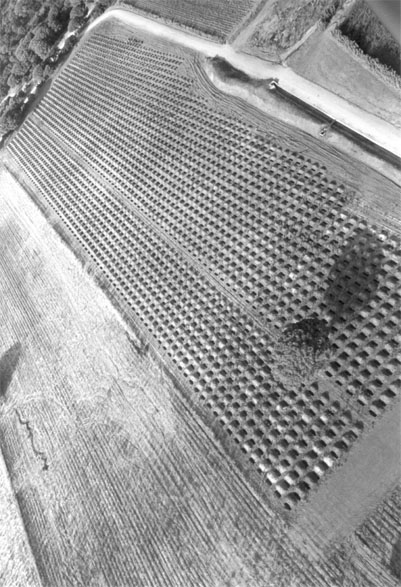
Sierra's work involved hiring a series of day labourers to dig 3000 holes of the above dimension in a lot on the coast of Morocco, which commonly receives illegal immigrants from Africa. The workers were mostly African: Senegalese, with a few Moroccans, working under a Spanish foreman. Each worker was paid the government-mandated sum for day labourers, a bit more than 50 euros a day. As you can see, it reads disturbingly like a graveyard.

Santiago's work focuses chiefly on themes of exploitation and the invisible labour of classes outside of a mostly bourgeois contemporary art community: "[w]hat becomes singularly apparent is just how dependent the type of earnings source is on social and racial hierarchies" (Mackert). He tends to focus his attention on the difficulties of those who are illegal, addicted or struggling to survive by employing them to do unproductive, repetitive, work-like activities: "[...] a worker who takes part in one of Sierra's pieces is a worker more due to his availability and his willingness to work than to his believing that what he does is in effect work" (Jimenez).

In this way, a vast divide is made apparent between the art-viewing subjects and the art-making subjects, and though this piece obviously takes cues from both minimalist and land art aesthetics, its content is far more subjective and referential to its creators and the social context of the land it occupies.

Relational Work : M. Simon Levin & Laurie Long - Centre for S.A.L.T. Expression (2003)

In 2003, Levin and Long created an imaginary organization to encourage further artistic mediation between the residents of Kelberrin, Australia & their environment, which has been oversalinated due to unsustainable farming practices. One aspect of the piece involved volunteers, who wore a GPS bandoleer in their everyday interaction with their environment. Traces of their paths were painted on the walls of the gallery.

I find that it is generally a successful performance work that implicates an audience in its success, particularly when the work generates questions and commentary surrounding environmental issues that adversely affect the entire community.


works cited

Jimenez, Carlos. "Santiago Sierra: Or Art in a Post-Fordist Society". Art Nexus 3 no. 56 64-9 Ap/Je 2005. ART FullText. ECUAD Library, Vancouver BC. 23 Feb. 2009.

Mackert, Gabriele. "Santiago Sierra". European Photography no73. 13-22 (2003). ART FullText. CUAD Library, Vancouver BC. 23 Feb. 2009.

Phillips, Patricia C. "Remediations--Re-Viewing Art." Art Journal 65.3 (2006): 5-5. Academic Search Premier. EBSCO. ECUAD Library, Vancouver BC. 23 Feb. 2009.

Ward, Frazer. "Alien Duration: Tehching Hsieh, 1978-99." Art Journal 65.3 (2006): 6-19. Academic Search Premier. EBSCO. ECUAD Library, Vancouver BC. 23 Feb. 2009.

Wednesday, February 4, 2009

shadow puppetry

GROUP 1

tea

The performance began with a girl's silhouette plucking flowers from her hand while chanting "He loves me, he loves me not". She is offered a teacup, and drinks. Suddenly ...

planets

she is joined by swirling planets and a large dragonfly, and she herself sprouts wings. The swirling of planets is used as a visual motif throughout the extent of the piece, as a transition. At some point she begins to strip, and is watched by a silhouette in the corner.

kick

When she discovers this, her silhouette transforms into a large boot that kicks the peeping tom (repeatedly!) in the face.

The performance ends in a similar tableau to the beginning.


GROUP 2

The piece begins with a large sleeping silhouette that spews forth a slinky-looking character that travels through ...

mountain

... a mountain (that looks like it's on fire) ...

ocean

... an ocean (with bubbles that unfortunately didn't show up well in the images) ...

face

... and other transitions before returning back to the sleeping dreamer.

The sound for this piece was an ambient track.

GROUP 3

The piece happened in three parts.

maskmush

Within the first part of the piece, what seemed like a lump resolved itself into a mask of a pig's head through manipulation with hands, and then was re-crumped into a ball.

police

During the second part, a silhouette wearing a mask and displaying a potbelly sang weirdly into what looked like a microphone.

police pig

During the third part, the profiled silhouettes of the pig's-head mask and two other masks have what seems like a showdown, with the pig's-head mask eventually becoming larger and flooding the screen.

GROUP 4

lens

eat

fight

Wednesday, January 21, 2009

performance artist presentation

TRISTAN TZARA - THE GAS HEART


-one of the chief instigators of Dada
-wrote absurd theatre, as well as co-pioneering the contemporary, Western idea of spoken word/poetry performance

the gas heart (1921) (translated by Michael Benedikt)

Tzara's work is striking to me because he so heavily employs repetition ... he creates a sense of the ritualized nonsense of small talk throughout the play. He also seems to mock the other theatre of the time, which seemed to be mostly based on a blend of vaudeville and history plays, grand narratives and meaningless silliness.


LA MONTE YOUNG - COMPOSITIONS 1960


-experimental composer, contemporary of John Cage
-from Wikipedia:

His Compositions 1960 includes a number of unusual actions. Some of them are unperformable, but each deliberatively examines a certain presupposition about the nature of music and art and carries ideas to an extreme. One instructs: "draw a straight line and follow it" (a directive which he has said has guided his life and work since). Another instructs the performer to build a fire. Another states that "this piece is a little whirlpool out in the middle of the ocean." Another says the performer should release a butterfly into the room. Yet another challenges the performer to push a piano through a wall. Composition 1960 #7 proved especially pertinent to his future endeavors: it consisted of a B, an F#, a perfect fifth, and the instruction: "To be held for a long time."

I find Young's work compelling because, as a composer, he merely writes the instructions for a performance ... the performance itself can be carried out by other people, and therefore he isn't automatically implicated as the performer. In class I showed the exhibition catalogue for David Khang's recent work based around La Monte Young's Compositions 1960, proving that La Monte Young's work continues to be generative for a whole new generation.


COLETTE URBAN - CONSUMER CYCLONE


-from Colette Urban (exhibition catalogue) by Barbara Fisher & Colleen O'Neill

Consumer Cyclone 1993, 15 minutes

Consumer Cyclone is designed to be performed in a shopping mall. I am dressed in a black bodysuit -- attached to my front are articles of clothing and on my back a variety of small cosmetic and hand held mirrors. As I parade through the shopping mall I trail behind me an assortment of small beauty appliances and repeat over and over into a toy megaphone, "Regardez-moi. Regardez-toi. Look at me. Look at you."


This work seems to reference the tendency of consumerism to attempt to construct the illusion of identity through the purchase of items. By working in a public space designed for this very purpose, she confronts the people that are ostensibly in the space to consummate that lie with the possibility that they are also figuratively caught in this ritual of self-reflexive consumption.