 Durational Work : Tehching "Sam" Hsieh - Time Piece (1980-1981)
For one year, Tehching Hsieh (going by Sam at the time) attempted to punch a time clock every hour on the hour. Every punch of the clock was documented: by 366 punch cards signed by witness David Milne, at the time Executive Director of the Foundation for the Community of Artists in New York, who produced a statement to confirm that he had signed them; and by a single frame of 16mm film, creating a stopframe animation of his year at the clock that passes in about six minutes. He shaved his head at the beginning of the performance to show the passage of time, and produced documentation of his failures to punch the clock (only 134 times out of a potential 8,760). A statement produced by Milne at the end of the piece confirms the authenticity of his signatures on the cards, and the fact that the 16mm film strip is unaltered.
At the time, Hsieh was living as an illegal alien in New York City, and had been since 1974. An illegal alien is deported if apprehended and is thus a "subject without rights but
nonetheless defined by the exercise of legal force" (Ward). A curious interstitial space to occupy as a performance artist. Hsieh's neurotically notarized documentation of his life at the clock seems to mimic the idea of employee surveillance, "hyperboliz[ing] the
subjection of the worker--which Hsieh couldn't legally be--to disciplinary observation" (Ward).
Hsieh's work seems desperately anonymous; a repetitive, mechanistic task rendered simultaneously visible (in documentation of a shutter-length snapshot of interstitial time) and invisible (in the opacity of the contents of the timespace between frames). He simultaneously pairs commentary on the American valorization of work and "unsettling and shockingly prescient questions about the economic, juridical, political, and documentary systems of exclusion and immigration, alienation and assimilation" (Phillips).
I am fairly detail-oriented, so one of the most perplexing aspects of the piece for me was that all of his documentation for this piece (and Cage Piece, 1978-1979) was signed "Sam"; thereafter he used "Tehching". I wonder whether or not this was a conscious decision to further comment on assimilation, or whether he was actually attempting to assimilate into an anglicized world, or whether or not he went by Sam to avoid detection and deportation. I wasn't able to find any concrete information on the matter.
the 16mm film documentation
contemporary internet-based work inspired by Hsieh's Cage Piece.
Community-Based Work : Santiago Sierra - 3000 holes of 180 X 50 X 50 CM each (2002)
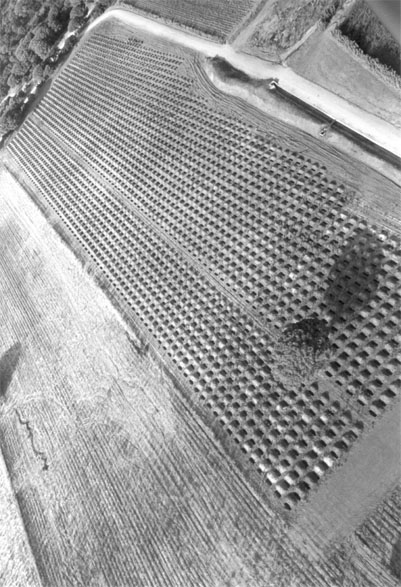
Sierra's work involved hiring a series of day labourers to dig 3000 holes of the above dimension in a lot on the coast of Morocco, which commonly receives illegal immigrants from Africa. The workers were mostly African: Senegalese, with a few Moroccans, working under a Spanish foreman. Each worker was paid the government-mandated sum for day labourers, a bit more than 50 euros a day. As you can see, it reads disturbingly like a graveyard.
Santiago's work focuses chiefly on themes of exploitation and the invisible labour of classes outside of a mostly bourgeois contemporary art community: "[w]hat becomes singularly apparent is just how dependent the type of earnings source is on social and racial hierarchies" (Mackert). He tends to focus his attention on the difficulties of those who are illegal, addicted or struggling to survive by employing them to do unproductive, repetitive, work-like activities: "[...] a worker who takes part in one of Sierra's pieces is a worker more due to his availability and his willingness to work than to his believing that what he does is in effect work" (Jimenez).
In this way, a vast divide is made apparent between the art-viewing subjects and the art-making subjects, and though this piece obviously takes cues from both minimalist and land art aesthetics, its content is far more subjective and referential to its creators and the social context of the land it occupies.
Relational Work : M. Simon Levin & Laurie Long - Centre for S.A.L.T. Expression (2003)

In 2003, Levin and Long created an imaginary organization to encourage further artistic mediation between the residents of Kelberrin, Australia & their environment, which has been oversalinated due to unsustainable farming practices. One aspect of the piece involved volunteers, who wore a GPS bandoleer in their everyday interaction with their environment. Traces of their paths were painted on the walls of the gallery.
I find that it is generally a successful performance work that implicates an audience in its success, particularly when the work generates questions and commentary surrounding environmental issues that adversely affect the entire community.
works cited
Jimenez, Carlos. "Santiago Sierra: Or Art in a Post-Fordist Society". Art Nexus 3 no. 56 64-9 Ap/Je 2005. ART FullText. ECUAD Library, Vancouver BC. 23 Feb. 2009.
Mackert, Gabriele. "Santiago Sierra". European Photography no73. 13-22 (2003). ART FullText. CUAD Library, Vancouver BC. 23 Feb. 2009.
Phillips, Patricia C. "Remediations--Re-Viewing Art." Art Journal 65.3 (2006): 5-5. Academic Search Premier. EBSCO. ECUAD Library, Vancouver BC. 23 Feb. 2009.
Ward, Frazer. "Alien Duration: Tehching Hsieh, 1978-99." Art Journal 65.3 (2006): 6-19. Academic Search Premier. EBSCO. ECUAD Library, Vancouver BC. 23 Feb. 2009.


